NSSF at 40: Do not despise the day of Small Beginnings
Tuesday, July 28 2026 1:18 pm
By Paul Busharizi, Financial Journalist



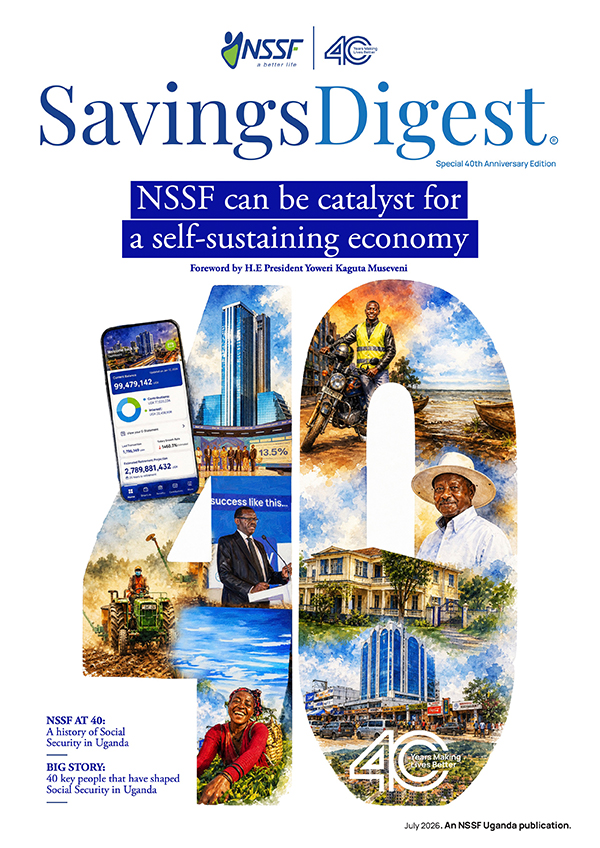
The history of the National Social Security Fund is a reminder of a truth that markets, institutions, and people alike keep relearning the hard way: do not despise small beginnings. Real institutions, like real capital, are not built in bursts. They are built in layers—through decisions that look insignificant at the time, through patience that attracts little applause, and through discipline that is often deeply unpopular.
Today, when the National Social Security Fund collects more than Shs 140 billion every month, sits on assets approaching Shs 30 trillion, and anchors a meaningful share of Uganda’s financial system, it is tempting to read its story backwards—as though success were inevitable. It was not. For much of its life, survival itself was the achievement.
Beginnings Without Glamour
When the modern NSSF was created under the 1985 Act, Uganda itself was barely standing. Inflation had destroyed savings, the banking system was fragile, and institutions were distrusted by default. Long-term thinking felt almost irresponsible in an economy organised around daily survival. Then came the defining trauma of 1987, when the currency reform reduced savings worth Shs 1.8 billion to about Shs 34 million. In one stroke, the Fund’s credibility—and that of formal saving itself—was shattered.
Yet even before that shock, NSSF’s fragility was visible in the most ordinary ways. In its early years, the Fund did not even have a home. Moses Stephen Owor, then Permanent Secretary in the ministry responsible for labour and effectively the scheme’s steward, later described those beginnings with stark simplicity.
“When we started, we had to house it,” Owor recalled. “I rented the house along Kampala Road for a long time.”
There was no headquarters, no permanence, no sense of institutional gravity—just borrowed space while the Fund tried to borrow credibility. But as contributions accumulated, Owor and his colleagues reached a critical conclusion: an institution meant to span generations could not live in rented rooms.
“As the fund was progressing, we found it fit that we should arrange to have its own permanent home,” he said. “There was a search for a plot of land where to build the house. We found the plot, paid, bought it, and contracted architects to start drawing the plan for the fund.”
Drawing lessons from Kenya and Nigeria—where social security institutions anchored themselves in large, income-generating headquarters—Owor envisioned a building that would both house the Fund and quietly earn for its members. Although he retired before it was completed, the vision, the land acquisition, and the initial design decisions were made under his watch. Workers House did not begin as an architectural statement. It began as an institutional decision: this Fund intended to exist for the long term.
That vision would prove indispensable in the lean years that followed.
Abel Katembwe and the Discipline of Foundations
When Abel Katembwe joined NSSF in 1990, barely five years after the law creating it had been enacted, the institution was operating on the edge of irrelevance. In 1989, total collections stood at about Shs 30 million, almost all of it swallowed by administration.
“There was no money,” Katembwe later recalled. “We collected about Shs 30 million, and all of it was going into administration.”
There was nothing to invest, no surplus to build with. By the time Katembwe left office, the Fund’s assets had reached roughly Shs 29 billion—a figure that only becomes meaningful when contrasted with today’s reality. Shs 29 billion is less than what NSSF now collects in a single week, in an era where monthly inflows exceed Shs 140 billion. The distance between those two numbers is the story of the last thirty years.
Katembwe’s first defining battle was compliance. The new NSSF law replaced the old flat contribution—Shs 40 from workers and Shs 40 from employers—with a far more ambitious regime: 5 percent of gross salary from employees and 10 percent from employers. Resistance was fierce and not confined to small players. Even powerful institutions like the Bank of Uganda and Uganda Commercial Bank pushed back.
This was not a technical disagreement; it was a test of whether the Fund had authority at all. Katembwe chose enforcement over accommodation. In a political culture where confronting “big shots” was rare, his administration made examples of prominent defaulters.
Compliance improved. Contributions rose. And for the first time, the Fund generated investable surpluses. Without that discipline, nothing that followed—no real estate, no equities, no digital systems—would have been possible.
It was during Katembwe’s tenure that the most misunderstood asset in NSSF’s history was reclaimed. Workers House, far from being a functioning project, was—in his blunt words—
“just a hole in the ground with steel bars sticking out.”
Abandoned since the 1970s, the site had degenerated badly.
“It had been used for more than twenty years as a den for thieves,” Katembwe said. “We even found seven guns there.”
Completing Workers House was controversial. Many questioned why workers’ savings should be sunk into concrete and steel instead of liquid instruments. But Katembwe persisted. Under his administration, the superstructure was built, transforming an abandoned excavation into a tangible asset that future leaders could complete.
Alongside Workers House came modest but strategic real-estate investments in Bukoto and Namuwongo, disciplined placements in treasury bills, and a decision whose importance would only become clear much later: the beginning of computerisation. At a time when most public institutions were entirely paper-based, Katembwe’s administration initiated automated member records and contribution tracking. This effort was backed by US$700,000 from the International Labour Organisation, specifically secured to begin the transition away from paper.
In hindsight, this early digital seed was decisive. The sophisticated systems that later enabled compliance tracking, member statements, and service delivery did not appear overnight; they were planted when the Fund barely had vehicles that worked.
Perhaps the most consequential—and unresolved—legacy of the Katembwe era was philosophical. His administration attempted to transform NSSF from a provident fund into a true pension fund.
“Our motto was: we build for the future,” Katembwe said. “The promise in there was that NSSF would afford its members a monthly pension till death.”
The proposal ran into political, institutional, and cultural resistance and stalled. When Katembwe left, the momentum was lost. The consequences are now painfully clear.
“The facts are clear,” he observed later. “Nearly eight in every ten members have blown their money in two years and are left to the mercy of God.”
The debate was never academic. It was about dignity in old age—and it remains unresolved.
From Turbulence to Turning Point
The early 2000s brought consolidation rather than expansion. Under Leonard Mpuuma, the focus was on stabilising benefit payments and reassuring members during administrative transition. It was a period of holding the line.
The late 2000s were more turbulent. Under David Chandi Jamwa, aggressive investment strategies delivered higher returns and record profits, but also exposed governance weaknesses. Scale had begun to arrive before discipline was fully embedded.
By 2009, interest paid to members had fallen as low as 3 percent. Public confidence ebbed once again. NSSF was widely discussed as a problem institution—important, unavoidable, but deeply mistrusted.
The decisive turning point came in 2010.
The Byarugaba Reset and the Culture of Fairness
When Richard Byarugaba took over leadership in 2010, he inherited a Fund with an asset base of just over Shs 2 trillion, broken processes, and a damaged reputation. What followed over the next decade was not just financial growth, but institutional reconstruction.
Byarugaba’s most enduring contribution was cultural. Performance was aligned to strategy through the Balanced Scorecard. Appraisals became objective. Rewards were tied to results. Poor performance carried consequences. For the first time, staff believed that effort mattered.
That perception of fairness became the invisible engine of change. He was very instrumental in development and execution of vision 2025, growing the Fund to UGX 20 trillion.
Patrick Ayota and the Mathematics of Trust
Patrick Ayota took over from Byarugaba and cemented the Fund’s position as a critical pillar in Uganda’s economic development. In an interview reflecting on the Fund’s transformation, current CEO Patrick Ayota quantified the distance travelled with brutal clarity.
In 2010, customer satisfaction stood at 49 percent, staff satisfaction at 50 percent, average claims processing took 105 days, and the asset base was Shs 2.128 trillion.
“There is a correlation between the two,” Ayota notes. “If staff are not satisfied, it is impossible to treat customers well.”
By the end of 2025, the picture was radically different. Assets had grown to Shs 28.79 trillion. Customer satisfaction had risen to 88 percent, staff satisfaction to 91 percent, and average claims processing time had fallen to 4.7 days.
Ayota attributes these results to a work-culture shift driven by strategic clarity, crediting Byarugaba’s leadership.
“A perception of fairness has been created thanks to our adoption of the Balanced Scorecard,” Ayota explains. “Performance was aligned with strategy, appraisals became objective, and from there we introduced significant rewards for good performance and consequence management for below-par performance.”
The results extended beyond metrics into trust. During the parliamentary probe of 2022, NSSF had 41,000 members aged 50 and above holding Shs 550 billion—people fully eligible to withdraw at the first sign of trouble.
What happened next surprised even management.
By June 2023, the number had risen to 61,000 members holding Shs 800 billion. By 2025, it had reached 79,000 members with more than Shs 1 trillion in savings.
“These are people who could have withdrawn their funds at the sign of trouble,” Ayota reflects. “They did the exact opposite.”
Trust, once lost, had been rebuilt.
Systemic Relevance and the Next Frontier
Today, NSSF accounts for roughly 11–12 percent of Uganda’s GDP, holds close to a quarter of government domestic debt, and has invested over UGX 1.45 trillion in local companies, equities, and real estate. It has quietly become a shadow development finance institution, mobilising long-term domestic savings in an economy chronically short of patient capital.
Looking ahead to Vision 2035, the ambitions are even higher: 95 percent stakeholder satisfaction, one-day claims processing, Shs 50 trillion in assets, and 50 percent coverage of the working population—about 15 million people.
Ayota is candid about what this requires.
“We will not be able to achieve this using traditional paths. With only about four million workers in the formal sector, we will have to go aggressively into the informal sector.”
That means boda boda riders—nearly two million today; 1,000 startups, estimated to add another one million contributors; and above all agriculture, where about 10 million Ugandans derive their livelihoods.
Do Not Despise Small Beginnings
Seen over four decades, the NSSF story mirrors Uganda’s own economic journey: fragile beginnings, improvisation, painful reform, institutional learning, and eventual confidence.
From Moses Stephen Owor renting offices on Kampala Road, to Abel Katembwe enforcing compliance and reclaiming a criminal den to build Workers House; from paper records to digital platforms; from mistrust to members choosing to stay even when they could leave—the Fund’s evolution reminds us that institutions are built the same way wealth is built: slowly, deliberately, and often invisibly.
At forty, NSSF is no longer just a savings scheme. It is a pillar of Uganda’s financial system—and living proof that when small beginnings are respected and compounded, they can carry an entire economy forward.