From the Farm to the Future: Global Approaches to Social Security for Farmers
Wednesday, October 21 2026 3:30 pm
By Paul Busharizi, Financial Journalist



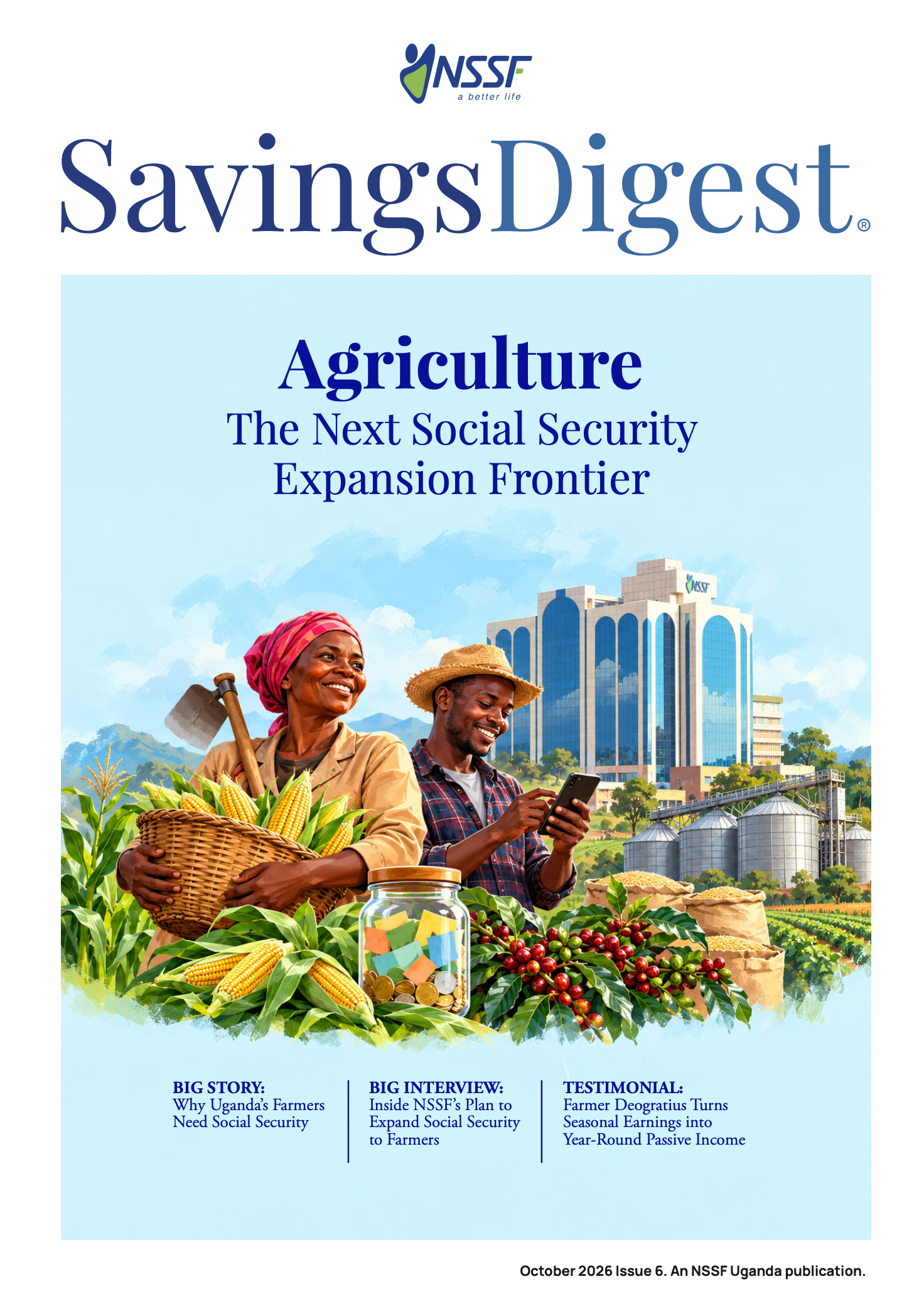
When most people think about social security, they picture office workers, teachers, bankers and civil servants contributing a portion of their salaries every month towards retirement.
That is hardly surprising. Most social security systems around the world were designed around formal employment, where employers deduct contributions from salaries and remit them to pension funds.
Agriculture does not fit neatly into that model.
Farmers are largely self employed. Their incomes fluctuate with seasons, weather patterns, commodity prices and harvest cycles. Many operate outside formal payroll systems altogether. As a result, agricultural workers have historically been among the least protected members of society, often spending a lifetime feeding the nation only to face old age without pensions, health insurance or income security.
For Uganda, this is not a marginal policy issue. It is a national economic challenge. More than 37.1 percent of Ugandans derive their livelihoods directly or indirectly from agriculture. Yet the overwhelming majority are smallholder and subsistence farmers. They live largely from one harvest to the next, selling only modest surpluses after meeting household needs.
Their immediate concern is rarely retirement 20 or 30 years away. It is finding enough money for school fees, farm inputs or a medical emergency. That hand to mouth existence makes voluntary saving for the long term extraordinarily difficult and leaves millions vulnerable to poverty in old age.
There are several countries that have found ways to overcome this challenge. Brazil, Poland, Rwanda, Kenya, Ghana and India have all experimented with extending social security coverage to farmers and informal workers. Their experiences offer important lessons for Uganda as it considers how to provide retirement security to the majority of its population.
The stakes are much bigger than pensions. Done correctly, social security for agricultural workers could become one of the most important economic reforms of the next generation.
Brazil: Social Security as Rural Development
Brazil’s experience is perhaps the most ambitious.
Before the 1980s, social security coverage was largely concentrated among urban workers. The country’s 1988 Constitution dramatically expanded protection to rural populations, including smallholder farmers, fishermen and other agricultural workers.
Rather than attempting to fit farmers into a conventional pension system based on payroll contributions, Brazil’s Rural Social Insurance Programme recognised the realities of agricultural livelihoods. Eligibility was based primarily on proof of participation in agricultural activity rather than monthly payroll contributions.
The scheme is financed through a combination of general taxation and levies on agricultural production, acknowledging that most farmers earn seasonally rather than through regular monthly salaries. Millions of rural households consequently gained access to pensions and income security in old age.
The results were remarkable. Today, Brazil’s rural pension programme reaches more than nine million beneficiaries and has been credited with significantly reducing rural poverty and inequality.
In many municipalities, pension payments became one of the largest and most stable sources of household income, improving nutrition, keeping grandchildren in school and sustaining local businesses during periods when farm incomes were low or unpredictable.
Brazil demonstrated an important principle: social security is not merely a welfare programme. It is an economic development tool capable of reducing poverty while strengthening rural economies.
Poland: Adapting to Agricultural Realities
Poland took a different route.
Recognising that farming differs fundamentally from salaried employment, it established the Agricultural Social Insurance Fund (KRUS), a dedicated institution serving farmers separately from the general social security system.
KRUS is financed through farmer contributions complemented by government support and provides pensions, disability benefits, accident insurance and survivor benefits through a framework designed specifically for agricultural households.
The rationale was straightforward. Farmers earn seasonally rather than monthly, which means their incomes fluctuate significantly while family labour and ownership are often intertwined. A standard pension model based on payroll contributions would therefore have excluded much of the rural population.
Poland’s experience highlights an important lesson: social security systems must adapt to the realities of agriculture rather than expecting farmers to fit into systems designed for urban workers.
Lessons from Africa and Asia
Other countries have experimented with contributory schemes aimed at informal workers and farmers.
In Rwanda, the Ejo Heza savings scheme uses digital enrolment, flexible contributions and government incentives to attract workers in the informal sector. The programme has achieved impressive enrolment figures and demonstrated how technology can lower barriers to participation. Its challenge remains contribution consistency, as many participants with low incomes struggle to save regularly.
Kenya’s Mbao Pension Plan was designed around a simple idea: allow informal workers to contribute very small amounts through mobile money. The scheme proved that technology can dramatically reduce transaction costs, but it also highlighted the limits of voluntary participation. Many contributors save irregularly because competing household needs take priority.
Ghana has relied on community structures and digital platforms to expand pension coverage among informal workers. The lesson from Ghana is that trust matters as much as technology. People are more likely to participate when they understand the scheme and trust those administering it.
India has expanded coverage through contributory pension schemes supported by government contributions that supplement those made by participants. These incentives have boosted enrolment but have also raised questions about fiscal sustainability over the long term.
Taken together, these experiences reveal a common lesson. Voluntary participation alone rarely achieves mass coverage. When incomes are irregular and immediate needs are pressing, retirement savings are almost always postponed.
School fees come first. Food comes first. Medical bills come first. Farm inputs come first. Retirement becomes tomorrow’s problem.
That is why the world’s most successful pension systems rely heavily on automatic deductions or mandatory contributions.
Agriculture Is Bigger Than Farming
One important point often gets overlooked. Agriculture is not merely farming; it is an entire economic ecosystem stretching from the farm to the consumer’s table. It includes input suppliers, agro dealers, transporters, warehouse operators, processors, exporters, retailers, financiers, insurers and numerous service providers.
As economies develop, fewer people work directly on farms while more find employment in activities linked to agriculture. This process, agro industrialisation, is one of the most powerful drivers of economic transformation.
A worker in a dairy processing plant, coffee hulling factory, grain mill, logistics company, export warehouse or agro processing facility can easily be brought into the social security system through conventional payroll deductions.
In many respects, agro industrialisation is itself a social security strategy. The more value addition Uganda undertakes domestically, the more workers naturally move into formal employment and become contributors to existing pension schemes.
This is one more reason Uganda should aggressively pursue agro industrialisation. It creates jobs, raises incomes, broadens the tax base and expands social security coverage simultaneously.
But it still leaves one critical challenge unresolved: the farmer.
The Smallholder Challenge
Uganda’s agricultural sector remains dominated by smallholders, many of whom are subsistence producers.
They may sell coffee once or twice a year, deliver milk daily but in small quantities, or grow maize, beans, cassava or bananas primarily for household consumption and sell only occasional surpluses. These farmers rarely receive regular salaries, maintain formal payroll records or enjoy predictable cash flows.
This creates the central policy challenge: how do you bring into the social security system people whose economic lives are largely informal?
The answer lies in recognising that the collection mechanism must follow the farmer’s income stream. Rather than expecting farmers to make monthly pension contributions voluntarily, contributions can be linked directly to agricultural transactions.
Coffee farmers can contribute when they sell coffee. Milk producers can contribute through dairy collection centres. Tea growers can contribute through factory deliveries. Sugarcane farmers can contribute through mill payments. Livestock producers can contribute through formal livestock markets and abattoirs.
Commodity buyers, cooperatives, processors, exporters and digital payment platforms can become collection agents. In effect, social security contributions become integrated into agricultural value chains.
The product follows the farmer’s money.
Why Farmer Contributions Matter
Whenever discussions about extending social security arise, there is a natural temptation to look towards the Treasury for funding. That would be a mistake.
The success of social security systems over the long term rests on a simple principle: contributors largely fund their own benefits. This principle is particularly important in Uganda.
Governments change. Fiscal priorities shift. Economic crises emerge. Budget pressures intensify. In the end, a pension system heavily dependent on Treasury transfers eventually becomes vulnerable to politics and fiscal constraints.
A model funded by contributors offers a more durable alternative. When farmers contribute towards their own retirement, they develop ownership of the system. Their savings accumulate and are invested. Investment returns strengthen the fund over time.
The government still has an important role to play by providing regulation, oversight, consumer protection and targeted incentives during the early years. But it should not become the primary financier.
The Bigger Prize
The debate about social security for farmers is often framed narrowly as a retirement issue. That misses the bigger opportunity.
Social security protects people from poverty in old age. It builds resilience against illness and economic shocks. Most importantly, it mobilises savings for investment and national development over the long term.
The Fund provides perhaps the best example. By mobilising mandatory savings from less than one fifth of the country’s workforce, The Fund has become one of East Africa’s largest institutional investors, financing government securities, supporting capital markets, investing in real estate and strengthening financial stability.
Now imagine applying the same principle to agriculture.
More than 37.1 percent of Ugandans derive their livelihoods from agriculture and related activities. Mobilising even modest contributions from this segment would create one of the largest pools of domestic capital in East Africa.
Those savings could finance infrastructure, agro industrialisation, housing, manufacturing and private enterprise while simultaneously providing retirement security to millions of farming households.
A Reform Whose Time Has Come
The experiences of Brazil and Poland demonstrate that farmers can be successfully incorporated into social security systems. Rwanda, Kenya, Ghana and India show both the promise and the limitations of contributory schemes aimed at informal workers.
Together, they point towards a common conclusion: farmers need more than encouragement to save. They need systems that make saving automatic, regular and sustainable.
For Uganda, the solution lies in combining agro industrialisation with pension contributions linked to agricultural value chains. Agro industrialisation will naturally bring more workers into formal employment. But millions of smallholder farmers will remain outside conventional pension arrangements for years to come.
That is why Uganda needs a dedicated approach tailored to agricultural realities, built around farmer contributions, integrated into agricultural transactions and designed to minimise dependence on the Treasury.
If Uganda gets this right, the benefits will extend far beyond retirement security. It will create a culture of saving for the long term among the majority of the population, mobilise vast pools of domestic capital and bring the country’s largest economic sector into the heart of its financial system.
That would not simply transform retirement security. It would help transform Uganda itself.