Inside NSSF’s Plan to Expand Social Security to Farmers
Wednesday, October 21 2026 4:00 pm
By Julius Businge, Financial Journalist



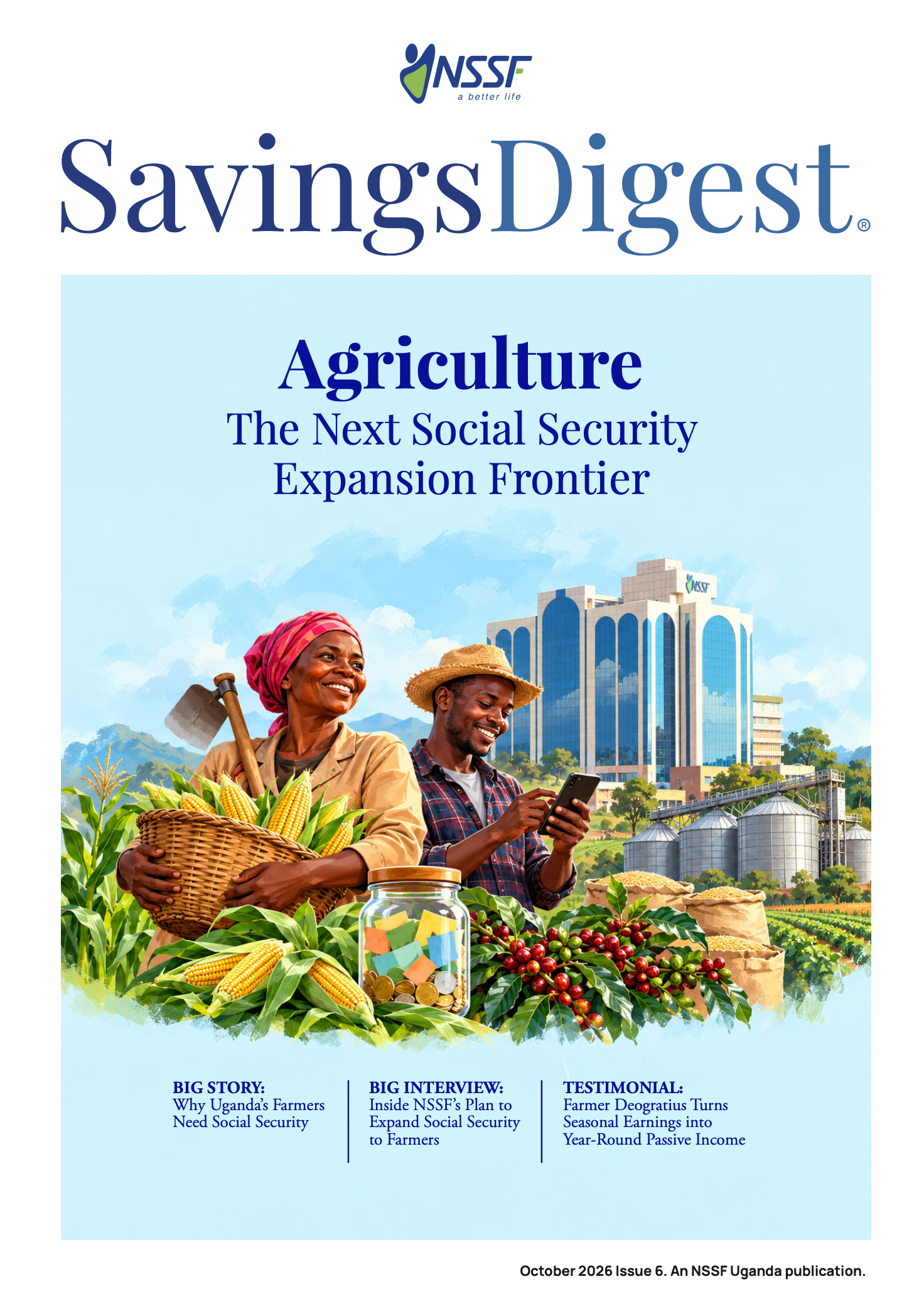
Although agriculture employs 37.1% of Uganda’s population, its contribution to formal savings remains disproportionately low. The Fund’s Chief Strategy and Performance Officer, Alex Rumanyika, shares the innovative solutions being rolled out to make saving more accessible, affordable and practical for farmers.
The agriculture sector is one of Uganda’s biggest employers. Does this translate into contributions and a stronger savings culture?
Indeed, the agriculture sector employs 37.1% of the country’s population, but contributions to formal savings remain disproportionately low.
What challenges have you identified among farmers when it comes to saving for their future?
Farmers face a host of challenges that affect their income flows and, consequently, their ability to save.
The first major issue is their high dependence on rainfall for agricultural production. The second is access to technical expertise to help them increase productivity. There is also the unaffordable cost of inputs and the cash constraints farmers face before the harvest season.
How is The Fund trying to address these challenges?
We are taking a multifaceted approach. The first step was introducing the SmartLife Flexi savings option. It is a brilliant initiative because it introduced mainstream investment products to what we commonly refer to as the informal sector.
Most unit trust products currently require a minimum investment of UGX 100,000. The same is true if you want to invest in bonds. SmartLife Flexi broke this threshold by bringing the minimum saving amount down to UGX 500.
In many ways, this was analogous to how Muhammad Yunus and Grameen Bank pioneered microfinance banking, targeting farmers with the lowest incomes in Bangladesh with flexible credit tailored to their small businesses.
With 80% of smallholder farmers earning UGX 1 million or less per year, persuading them to invest UGX 100,000 of that would be a tall order. SmartLife Flexi can be tailored to help them progressively build the liquidity needed to graduate into opportunities that generate higher earnings.
Even with a low minimum contribution, farmers have irregular incomes. How does SmartLife Flexi enable farmers and informal workers to save consistently despite seasonal earnings?
We have worked within farmers’ lifestyles to integrate SmartLife Flexi savings seamlessly into their earnings.
Farmers largely face two major problems: liquidity to purchase farming inputs and sustain themselves before harvest, and certainty that their harvest will be purchased at a fair price.
In our pilot, we attempted to solve these problems by strategically partnering with a large buyer to:
- Train farmers in more sustainable agronomy practices to improve harvest quality and productivity, leading to better earnings.
- Integrate financial literacy into the training curriculum to explain the benefits of saving, including saving with SmartLife Flexi.
- Automate savings deductions from payments to farmers at source using a simple formula, such as UGX 20 per kilogram of maize last season.
Through farming technical assistants (FTAs), we have also created an engagement model that encourages farmers to save voluntarily in addition to the automated deductions.
Are there solutions that help farming communities build a savings culture collectively?
Farmers are increasingly organised into village savings and loan associations (VSLAs) and savings and credit cooperatives (SACCOs). These membership organisations enable farmers to access services and financial products that would not easily be accessible if they transacted individually.
We have a SmartLife Group savings model that simplifies member registration through a bulk registration capability.
It also makes it easier for group administrators to track savings progress collectively and identify individual members who may be falling behind.
How does The Fund plan to extend these services to underserved rural areas across the country?
Partnerships are at the core of how we conduct business. The Fund’s services are available at different agent points through our partnerships with third parties.
Agent banking has become widespread in Uganda. A person can perform almost every type of banking transaction through an agent that they would at a bank branch.
To date, we have 20,000 agents deployed in the field to support onboarding onto SmartLife Flexi. Agents have helped reduce the cost of accessing financial services across Uganda.
By integrating our savings products into some credit and telecommunications products, agents will accelerate the uptake of pension products in underserved areas.
We are piloting these integrated savings models with key partners in the telecommunications and banking sectors and are hopeful that the market will be receptive.
With mobile money widely used by farmers and informal workers, how has The Fund integrated these channels to make saving more accessible and convenient?
The Fund’s purpose speaks to this: to make life better through saving as a lifestyle.
Rather than reinventing the wheel, we have integrated a flexible savings solution into existing lifestyle services.
The main channels enabling access to SmartLife today are MTN Mobile Money, Stanbic FlexiPay and Airtel Money. Members use these channels to add money to their savings accounts and withdraw funds.
We have also simplified saving by enabling automated and scheduled deductions through banks and telecommunications providers.
The Fund has plans to create the National Marketing Company. What progress has been made, and how is NAMCO expected to support farmers?
NAMCO is expected to provide market access guarantees to farmers.
Take maize as an example. Farmers face a range of challenges. When they plant, they do so with an earnings expectation in mind. However, at peak harvest season, a glut in supply can cause prices to fall considerably.
The logical response is to wait until prices match the expectations set at the beginning of the season, but farmers often lack storage facilities.
In our pilot, our purchasing partner offers farmers guaranteed storage supported by a voucher certifying the quantity and quality of maize delivered. Farmers receive regular updates on price movements and can choose to redeem their vouchers once market prices match their expectations.
This service, known as “storage as a service”, gives farmers greater certainty over their earnings and is gradually addressing unfair practices by middlemen.
It is still early in the process of providing a comprehensive solution for agricultural workers. For now, NAMCO is offering an assured market, confidence that the harvest will be bought, and a savings platform for farmers.
Farmers need an integrated intervention that enables them to access all necessary services through one platform, whether inputs such as fertiliser or credit to pay school fees. These services should be linked to their expected earnings through the assured market NAMCO offers.
We will continue to build additional services and products into a comprehensive ecosystem for farmers.
How many agricultural workers has The Fund reached through SmartLife Flexi, and what growth milestones does it hope to achieve?
We are very much at the beginning of the NAMCO journey.
The pilot started just two months ago. To date, around 1,000 farmers have saved with SmartLife Flexi, with combined savings of approximately UGX 15 million.
The goal of the pilot was to secure at least 1,000 farmers saving on the platform, which has been achieved. As the January season approaches, we plan to scale up the intervention.
How does The Fund ensure that small contributions, such as UGX 500 per transaction, translate into meaningful financial security over the long term?
The major problem we need to address is access to reliable markets. We need to combine this with deliberate efforts to build smallholder farmers’ capacity to serve these markets consistently with the right quality and quantity.
With our partner, Asili Farms, we have integrated financial literacy training into its agronomy academy, which is now accessed by close to 10,000 farmers organised into VSLAs and SACCOs.
This model can be replicated across other agricultural value chains.
What is The Fund’s vision for using digital platforms, group savings models and market linkages to transform saving among Uganda’s agricultural workforce?
Our vision is to transform agriculture into a mainstream investment and enterprise opportunity in Uganda.
Digital technologies have given people with lower earnings the opportunity to invest in mainstream financial assets such as bonds and public equities. The same can happen in agriculture.
Agriculture is an investment with the potential to generate high returns, and technology can help to:
- Enable members to pool resources to access land, tools and other assets.
- Monitor farm progress.
- Facilitate access to markets.
- Simplify accounting and payments.
- Automate savings from earnings.