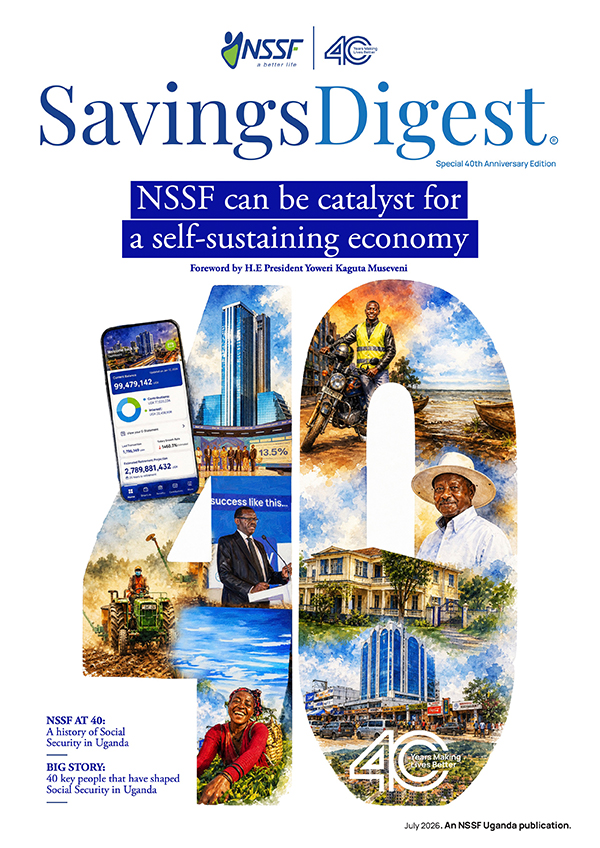
40 Years of National Social Security Fund (1985–2025)
Tuesday, July 28 2026 12:56 pm
By



1985-1989: Birth of the Modern NSSF
1985: Parliament passes the NSSF Act, transforming the Fund from a department under the Ministry of Labour into an autonomous statutory body.
Contribution rate revised to 15% (10% employer, 5% employee).
1987 Currency Reform: A devastating moment — the Uganda Shilling devaluation and 30% conversion tax shrinks NSSF savings from Shs 1.8 billion to Shs 34 million, severely eroding public confidence.
The Fund enters the late 1980s bruised but intact.
1990-1999: Survival and Slow Rebuild
Early 1990s marked by institutional fragility, weak systems, and limited public trust.
Gradual macroeconomic stabilization allows the Fund to regain operational footing.
Investment mandate largely conservative; credibility remains fragile.
Planning for a permanent headquarters (Workers House) resumes after years of delay.
2000-2009: Infrastructure and Governance Strain
2000: Completion of Workers House by Roko Construction - a long-delayed symbol of permanence.
Fund assets grow but governance challenges persist.
2001: Workers House officially commissioned on Labour Day by President Museveni.
2004: Presidential directive moves NSSF supervision from Labour to the Ministry of Finance, signalling concern over performance.
2008–2009: Public criticism peaks over inefficiencies and low returns (as low as 3% in 2009).
2010-2014: Turnaround Years
2010: New management team appointed, largely from the private sector, with a clear turnaround mandate.
2011: Uganda Retirement Benefits Regulatory Authority (URBRA) established, strengthening sector oversight.
Introduction of corporate strategy (2011–2014) anchored on:
- Customer satisfaction
- Profitability
- Productivity
- Readiness for liberalization
Balanced Scorecard adopted; internal performance culture shifts.
Interest paid to members rises steadily (6% in 2011, 10% in 2012).
2013: First NSSF Annual Members Meeting is held on March 19th 2013.
2015-2019: Confidence Restored
2015: Assets under management grow from Shs 2.7 trillion to Shs 5.6 trillion.
Interest paid to members jumps to 13%, restoring faith among savers.
Launch of Vision 2025, a 10-year strategy anchored on:
- Customer satisfaction (90%)
- Assets growth to Shs 20 trillion
- Faster benefit payments (target: 1 day)
- Innovation and product diversification
NSSF begins rebranding itself as a member-centric institution, not just a statutory collector.
2020-2022: Pandemic, Reform, and Expansion
COVID-19 exposes vulnerabilities in household savings and accelerates reform.
2021: Parliament passes the NSSF Amendment Act.
2022: Introduction of Mid-Term Access, allowing qualifying members early access to savings — over 90,000 beneficiaries.
Coverage expands beyond large formal employers to SMEs and informal sector workers.
Tripartite governance (Government, Workers, Employers) given firm legal footing.
2023-2025: Scale, Innovation, and Maturity
2024: Assets surpass Shs 20 trillion, beating Vision 2025 target ahead of schedule.
2025: Assets reach approximately Shs 26 trillion; membership exceeds 3.4 million, with over 113,000 employers.
Annual interest payout hits a record Shs 2.79 trillion (FY 2024/25).
Digital transformation matures:
- NSSF GO platforms (mobile, USSD, web, AI-assisted services)
- Straight-through processing and faster benefit payments
Hi-Innovator Programme surpasses job-creation targets, supporting over 200,000 jobs.
Transition underway from Vision 2025 to Vision 2035, targeting:
- 50% coverage of working Ugandans
- Shs 50 trillion in assets
- Stronger role in health, legacy wealth, and social investment