The right to social security should be a reality for all Ugandans
Tuesday, July 28 2026 1:48 pm
By Lt Gen (Rtd) Henry Tumukunde, Minister of Gender, Labour and Social Development



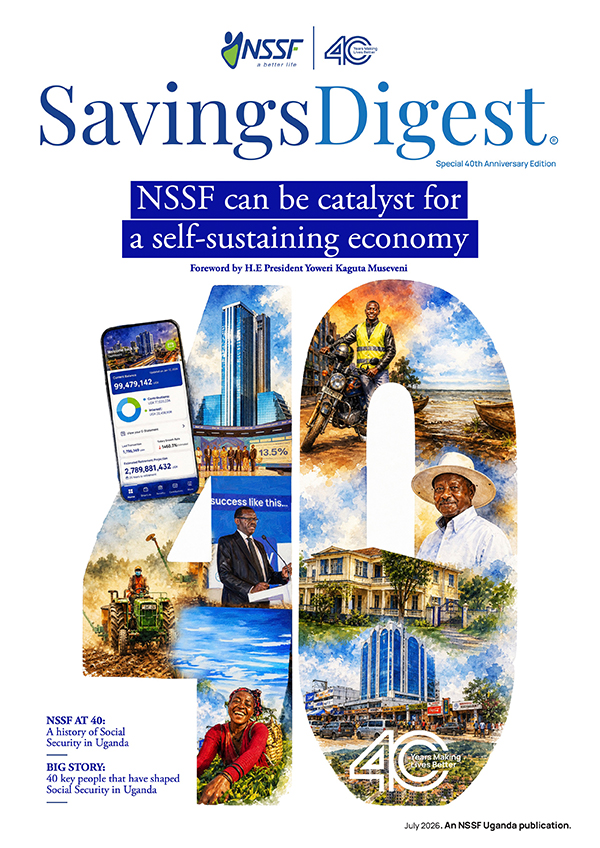
On the 40th anniversary of the National Social Security Fund (NSSF), I wish to congratulate the Fund’s Board, Management, Staff, and all members of the Fund upon this milestone.
What began as an idea in the late 1960s and was concretized into the National Social Security Fund (NSSF) Act of 1985 has now become a multi-trillion-shilling, dynamic, and innovative institution that is a model social security fund in Africa.
The idea of a national social security system evolved from the early community safety to formalized individual plans guided by the International Labour Organisation Social Security (Minimum Standards) Convention, 1952 (No. 102). This convention is an international treaty with a systemic vision of social security that defines the internationally accepted scope of social security. Uganda is a signatory.
Through this journey, the Fund has fulfilled its twin mandate – to provide social security services, while contributing to the economic development of the country.
While the achievements of the last 40 years should be celebrated, it is prudent to remind ourselves that the total working population currently stands at about 15 million, while the Uganda Registration Services Bureau puts the number of registered enterprises at about 850,000. This means that a significant number of workers remain out of the formal social security net.
The great news is that the government has put in place measures to unshackle the Fund to cast the net wider. These include the following:
- The National Social Protection Policy and Strategy - Social Security aspect that comprises both contributory and non-contributory arrangements of direct income support to the most vulnerable, as well as social insurance arrangements that mitigate risks
- Social security reforms – through the Amendments NSSF Act that took place in 2022, removed key bottlenecks the Fund faced in expanding coverage and innovating new products
- Voluntary membership regulations – the NSSF Voluntary Membership Regulations issued in 2024 that led to the introduction of voluntary membership open to all Ugandans
In addition to the above, the Fund must now take advantage of opportunities occasioned by a growing economy, young population, and new productive sectors like oil and gas, technology, and agricultural modernization.
By its own Strategic Plan, these measures should enable the Fund to improve social security coverage to about 8 million Ugandans over the next 10 years.
Lastly, social security has been classified as a universal human right. The Universal Declaration of Human Rights, 1948: Articles 22 and 25, establishes social security as a fundamental human right essential for dignity and the free development of personality. The International Covenant on Economic, Social and Cultural Rights, 1966, article 9, recognises the “right of everyone to social security, including social insurance.
The government, through my ministry, and working with other government partners, is committed to making this right a reality for all Ugandans in our lifetime.
I invite every stakeholder to play their role in supporting the Fund and the government in fulfillment of this mandate.