A Decade of Compounding Trust: NSSF Uganda in an Age of Disruption
Tuesday, July 28 2026 1:03 pm
By Paul Busharizi, Financial Journalist



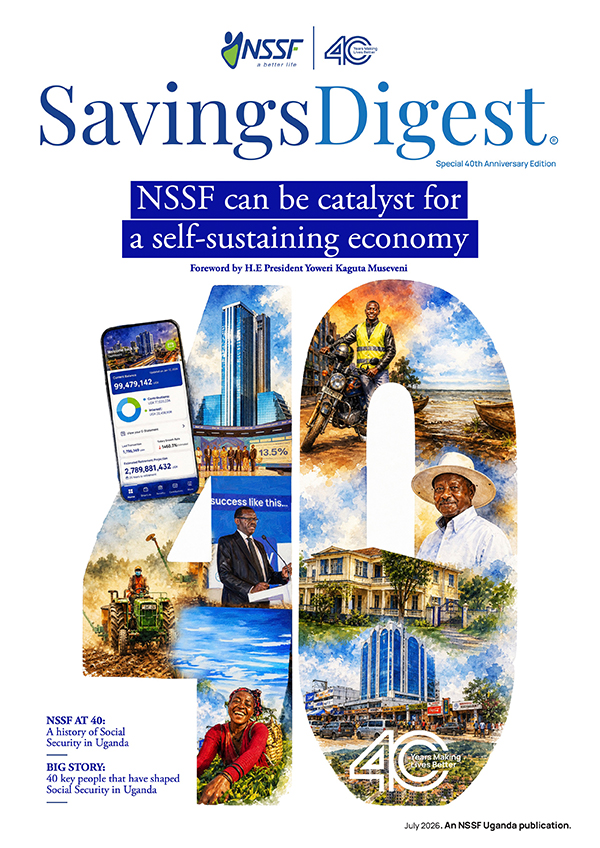
In finance, we understand compounding as the quiet force that turns modest deposits into substantial wealth. But it is not only money that can do this. Institutions compound too. Over the decade of 2015 to 2025, the National Social Security Fund (NSSF) did not simply expand its balance sheet. It compounded systems, leadership discipline, culture, governance credibility, and public trust.
The result was not merely a larger fund. It was a reinvented one.
To appreciate what happened at NSSF during this period, we must situate it within a broader global reality. As Richard Byarugaba, the former Managing Director NSSF often reminded audiences in his reflections on strategy, leadership today operates under VUCA conditions — volatility, uncertainty, complexity, and ambiguity. Strategy is no longer static; it is dynamic, data-driven, and deeply human.
Vision 2025
Between 2015 and 2025, NSSF internalised that truth.
When Byarugaba assumed leadership years earlier, the Fund was functioning but fragile. Customer satisfaction hovered below 50%. Staff satisfaction mirrored that number. Claims processing averaged 105 days. The asset base stood slightly above UGX 2 trillion.
By the end of 2025, assets had risen to nearly UGX 29 trillion. Customer satisfaction reached 88%. Staff satisfaction climbed to 91%. Claims were processed in under five days on average. Those statistics do not merely describe improvement. They describe institutional redesign.
Central to that redesign was strategic clarity, thus the birth of Vision 2025.
Vision 2025 was the Fund’s 10-year strategic plan (2015–2025) that focused on creating measurable value for members through growth, service improvements, and operational excellence. It framed the Fund’s priorities through clear targets and defined how NSSF aimed to serve its members better.
“My immediate priority was to understand who our real customer was. Initially everyone thought the member or the minister or unions were the primary customer. I reframed it: the employer is the customer because they decide to deduct and remit contributions,” Byarugaba says.
That reframing narrowed the problem. Once employers were defined as the primary strategic focus, everything else — compliance systems, technology redesign, relationship management, automation — aligned around reducing friction in remittance.
The strategy set out four major outcomes:
- Member Satisfaction: This targeted a 95% customer satisfaction rate (up from about 73% in 2015), ensuring members feel confident in the Fund’s services.
- Fund Growth: This aimed to grow assets under management to UGX 20 trillion, a significant increase from roughly UGX 5.5 trillion in 2015.
- Efficient Processes: These sought to streamline operations, including reducing benefit payout turnaround times (e.g., from about 15 days toward much faster service).
- Engaged Staff: The target was a 95% staff satisfaction rate, reinforcing the idea that a motivated workforce contributes to better outcomes for members.
Strategic execution followed disciplined logic. Leadership in disruption requires connecting the dots between global trends, internal realities, and deliberate strategic choices. The Fund did precisely that.
The first wave of reform attacked inefficiencies.
“There were multiple inefficiencies: an oversized branch network; very low automation; duplicated processes across branches,” Byarugaba says.
The deeper issue however, was cultural inertia.
“It was the hardest part. We shifted from a civil-service mentality to a private-sector, performance-oriented culture.”
Here, the balanced scorecard became the instrument of change, not as a reporting gimmick, but as an accountability engine. Performance was measured across four lenses: financial results, customer satisfaction, internal process efficiency, and organisational capacity.
Ambition was explicit — one-day benefit processing, 95 per cent satisfaction levels and a long-term audacious target of UGX 20 trillion in assets.
Those big targets were not public relations devices; they were internal alignment tools. As Byarugaba argued in his strategy reflections, small goals produce small organizations. Bold goals stretch talent and redefine norms.
Digitalisation
Technology was central to that transformation. In his strategic framework, digital is not an optional modernistion layer. It is the default operating model of future organisations.
At NSSF, digital meant straight-through processing. Employers could remit contributions electronically, eliminating suspense accounts and stale checks. Member apps offered transparency and real-time notifications. Paperless systems reduced processing cycles dramatically.
Byarugaba put it succinctly: “ Technology was central. We moved to straight-through processing… Paperless processes fundamentally changed efficiency.”
But digital transformation without cultural transformation fails — a point he repeatedly made in his presentation. Forty percent of digital initiatives globally fail at scaling. The Fund avoided that trap by aligning incentives with adoption. Performance bonuses were tied to measurable outcomes. Per diem privileges were consolidated into structured compensation. Hiring became deliberate, targeting agility and problem-solving orientation.
Culture compounded
This internal redesign occurred against a turbulent global backdrop. Byarugaba’s strategic lens emphasised the end of easy globalisation, shifting manufacturing geography, demographic transitions, and digital ubiquity. Sub-Saharan Africa, he noted, sits at a demographic inflection point — the youngest population globally, poised for industrial relocation if infrastructure, skills, and governance align.
For Uganda, these trends carried enormous implications. A young population creates urgency around job creation, savings mobilisation, and capital market deepening. NSSF’s growth thus sits within a broader macroeconomic narrative — domestic capital accumulation as a foundation for national transformation.
The Fund increasingly became more than a pension administrator. It evolved into a systemic economic actor.
That shift is unmistakable. From just over UGX 2 trillion in 2010 to nearly UGX 29 trillion in 2025, NSSF became the largest pension fund in East Africa. Such scale alters perception — and scrutiny.
Between 2021 and 2022, parliamentary investigations subjected the Fund to intense public examination. And governance under pressure reveals resilience — or weakness.
Patrick Ayota, who succeeded Byarugaba and had been part of the institutional transformation since 2011, saw a revealing data point during the probe: “In 2022 we had 41,000 members over 50 years old holding UGX 550 billion. Instead of withdrawing during the crisis, those numbers increased — 61,000 holding UGX 800 billion in 2023, and 79,000 holding over a trillion shillings in 2025. These are people who could withdraw at the first sign of trouble — but they did the opposite.”
Behaviour spoke louder than headlines. Trust had compounded.
Externally, governance credentials strengthened. In November 2025, NSSF Uganda won the regional category at the Chartered Governance Institute of Southern Africa Integrated Reporting Awards for the fifth time, co-hosted with the Johannesburg Stock Exchange. The citation praised its integrated thinking and responsible stewardship — language that aligns directly with global ESG frameworks.
In his presentation, Byarugaba noted that ESG is no longer peripheral. Global reporting standards are converging. Mandatory greenhouse reporting is expanding. Investors scrutinise governance structures. In that environment, compliance becomes competitive advantage.
NSSF’s integrated reporting posture signaled institutional maturity. Transparency was no longer defensive; it was strategic.
Regionally, the Fund became a benchmark. President William Ruto of Kenya publicly referenced Uganda’s pension scale, urging reform in Nairobi. When a head of state cites your metrics to challenge his own institutions, your influence has crossed borders.
Efficiency metrics reinforced that narrative. NSSF generated roughly UGX 18 in value for every shilling spent — an operational efficiency frequently cited as outperforming regional peers.
Now, the next decade’s real test lies beyond formal payroll systems.
Ayota frames the future bluntly:
“We will not be able to achieve our Vision 2035 targets using traditional paths. With only four million workers in the formal sector, we must aggressively pursue the informal economy.”
That ambition is expansive. Vision 2035 targets 50% coverage of the working population — approximately 15 million members — an asset base of UGX 50 trillion, stakeholder satisfaction of 95%, and claims processed in a single day.
Reaching that scale requires digital agility, product innovation, and experimentation — themes central to Byarugaba’s strategic philosophy. In his leadership reflections, he emphasised experimentation as a capability: test faster, cheaper, then iterate, then scale what works.
SmartLife Flexi represents a step in that direction — onboarding informal sector contributors through flexible, mobile-enabled savings. The challenge lies in scaling such products across boda boda riders, agricultural workers, and micro-enterprises.
This push into informality is not mere growth ambition. It is demographic necessity.
In his geopolitical analysis, Byarugaba cited futurist Peter Zeihan’s argument that countries like Uganda possess long-term structural advantages — youthful populations, agricultural potential, and industrial relocation opportunities — if policy coherence aligns with infrastructure and skill development.
Domestic capital mobilisation through institutions like NSSF becomes part of that national strategy. Pension funds are not neutral warehouses. They are levers of capital formation.
The continental pension conversation sharpens this point. South Africa’s pension assets exceed $300 billion — demonstrating the scale African domestic savings can achieve — while Nigerian regulators emphasise commercial viability in infrastructure investments.
NSSF Uganda now operates inside that continental arena. Its strategic questions mirror those of far larger funds, that is, how to balance safety, yield, liquidity, governance, and developmental aspiration.
As Ayota reflects on the transformation since 2010, the internal linkage between staff satisfaction and customer satisfaction remains central: “There is a correlation between the two. If staff are not satisfied, it is impossible to treat customers well.”
That recognition shaped investment in culture — a recurring theme in Byarugaba’s strategic teachings: culture eats strategy for breakfast, lunch, and supper.
Between 2015 and 2025, NSSF did not merely adopt digital tools. It cultivated performance accountability, data-driven investment analysis, disciplined asset allocation, and integrated reporting standards.
Each reinforced the other.
The Fund’s trajectory can be summarised without triumphalism: from inefficiency to digitised discipline; from public skepticism to behavioural trust; and from national actor to regional benchmark.
Yet neither Byarugaba nor Ayota presents the journey as complete.
Ayota looks forward.
“We have laid strong foundations — digital systems, governance credibility, performance culture and investment discipline. The next phase is about scale with purpose. We are aiming for UGX 50 trillion in assets and 50% workforce coverage. But the most important goal is sustaining trust through consistent performance.”
That sentence captures the lesson of the past decade. Growth without trust is unstable. Trust without performance erodes. But performance, measured consistently and aligned with purpose, compounds.
The story of NSSF Uganda over the past decade is not a miracle narrative. It is a systems narrative. Strategic clarity narrowed priorities. Culture aligned incentives. Technology reduced friction. Governance transparency built resilience. Regional benchmarking validated maturity.
At the end of the day, institutions compound what they reinforce. Between 2015 and 2025, NSSF reinforced performance, transparency, experimentation, and ambition. The dividends are visible.
The next decade will test whether that compounding accelerates as the Fund moves deeper into informality, larger capital market influence, and greater macroeconomic relevance.
But if the past ten years are an indicator, the trajectory suggests not just growth — but disciplined transformation.
And in an era defined by volatility, uncertainty, complexity, and ambiguity, disciplined transformation may be the most valuable asset of all.